Example
Time-travel game
A programming puzzle with time travel
A portal sends you back in time. Your past self keeps walking. Choose where the two versions of your character meet, then check the resulting timeline.
Each puzzle supplies a configuration to shared game rules. The source below shows where the configuration ends and the rules begin; the replay lets you inspect what those rules do.
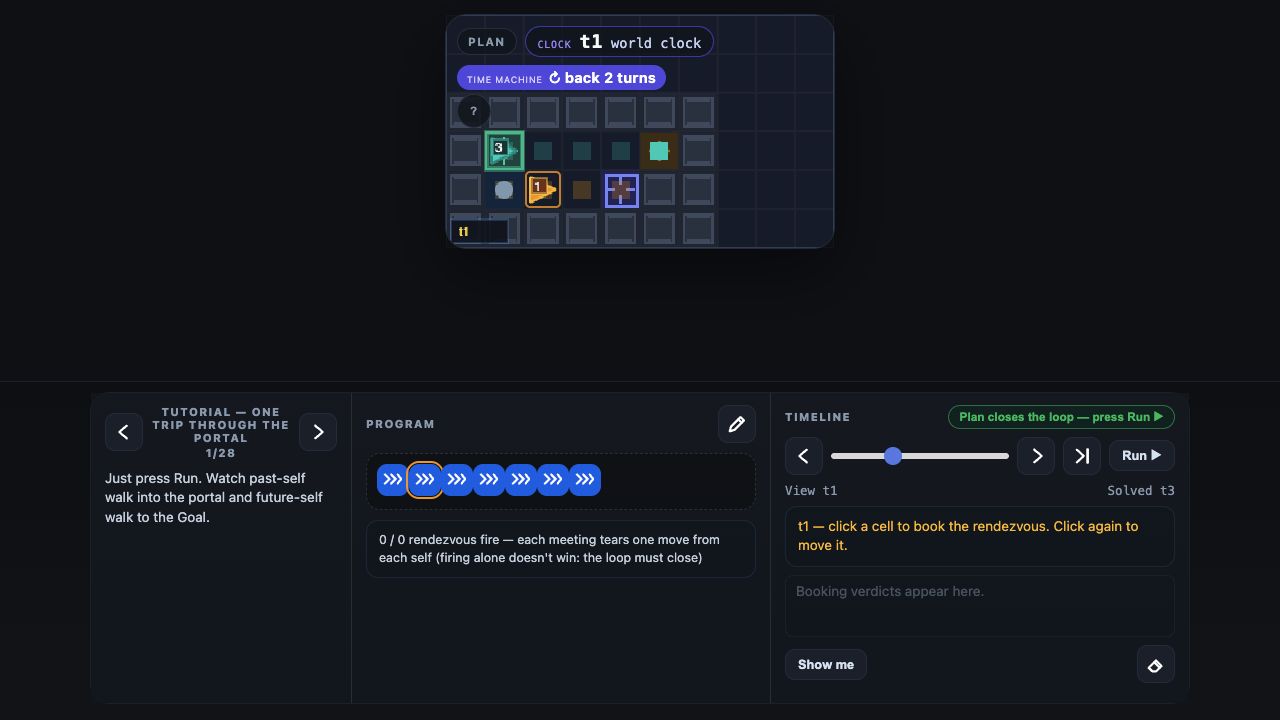
- Watch the first trip.Press Run. The character follows its recorded moves, enters the portal, and reappears earlier in the timeline.
- Book a rendezvous.In later puzzles, pick a cell and a turn where the two selves should meet. A collision tears one move out of each self’s program.
- Make the loop close.Scrub the timeline and inspect what happens. Adjust your bookings or moves, then run again. Help explains the controls; Show me reveals the intended plan.
An engine and its configuration
Describe a puzzle using the shared game rules
A new puzzle needs a board, portals, and a starting move sequence. It should not need a new timeline simulator or a new browser interface.
The configurations are written in Bosatsu. They construct a Puzzle value that the reusable game rules consume. The rules compute movement, collisions, and replay; Yichus’s browser runtime handles events and display. The game rules and UI are also written in Bosatsu—this example has more than just its configuration in the language.
Puzzle configuration / Bosatsu
A board, portals, and a recording
Each level supplies values to the same puzzle type.
Reusable rules / Bosatsu
Movement, collisions, and timeline replay
The same rules consume each level’s configuration.
Yichus browser runtime / JavaScript
Controls, state updates, and display
The host executes the generated program.
Here is the tutorial’s board configuration. Each set_cell produces a grid with the named cell changed; the final grid is passed to Puzzle alongside the portal and moves.
grid_0 = empty_grid(10, 6)
grid_1 = set_cell(grid_0, 1, 4, Start)
grid_2 = set_cell(grid_1, 4, 4, PortalIn)
grid_3 = set_cell(grid_2, 1, 3, PortalOut)
grid_4 = set_cell(grid_3, 5, 3, Goal)
Puzzle configuration & engine source Read the files, then run the shipped game
Editing moves while playing changes the player’s plan. Changing a level’s source changes the puzzle itself and currently requires a local build. Read the complete game source.
Back to Yichus · Try a simulation with Why explanations
Where this fits
What this is about: Why an Analyzable Language?